
At Sony LIV, we ingest tens of millions of video streaming events into ClickHouse Cloud and run queries to generate complex dashboards for analysis. This allows our operations team to monitor, alert & troubleshoot the QOS and QOE of our customers in real-time. ClickHouse Cloud has helped us to optimize costs and ensure the high availability and resilience of our services.
Observability built for agents, not just dashboards
ClickStack is designed for an observability future where humans and agents investigate side by side, using semantic tools that make ClickHouse’s real-time analytical power faster, more accurate, and more efficient.
Your agent in
Claude Code
Your agent in
Cursor / IDE
Your agent in
ClickStack Notebooks
Your agent in
OpenAI Codex
Your agent on
Internal platform
Your agent in
OpenCode
ClickStack
logstracesmetricseventsexceptions
Trusted for observability by





Join the companies choosing ClickStack as the platform for their agentic observability

Why agentic observability runs on ClickStack
Agentic observability demands more than dashboards. Built on ClickHouse, ClickStack combines high-concurrency analytics, full-fidelity telemetry, and semantic investigation tools to help agents investigate faster, reason more consistently, and operate at agent scale.

100%Telemetry retained
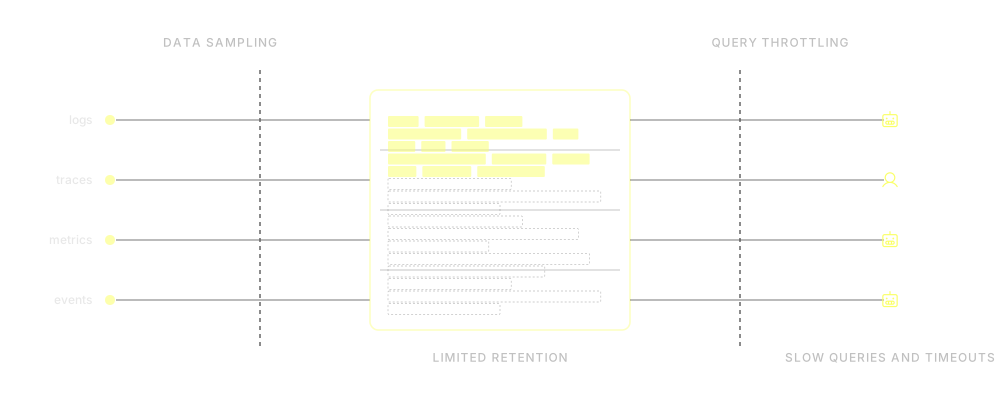
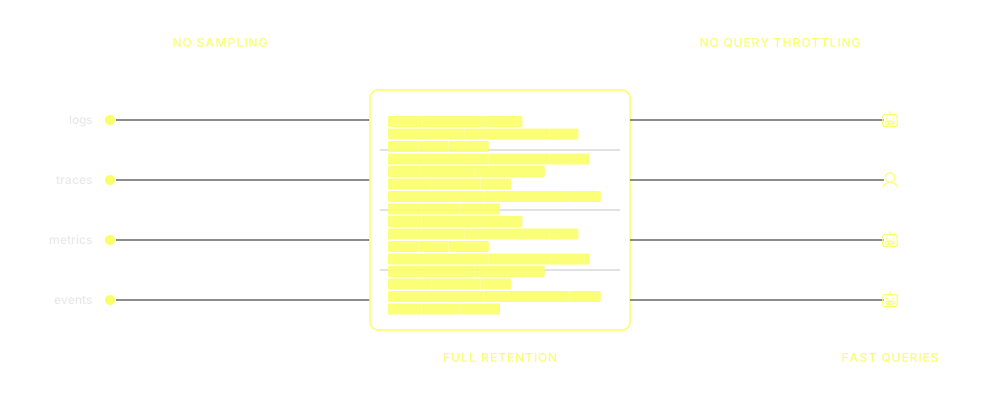
Agents investigate every log, trace, metric, and event with complete context, eliminating the blind spots introduced by sampling.
UnlimitedRetention
Long-term observability data provides the historical context agents need to identify trends, regressions, and recurring patterns.
0Query throttling
Agents can run thousands of concurrent queries to explore hypotheses and correlations in parallel without artificial limits.
<1sQuery speed
Sub-second analytics keep investigations collaborative, allowing agents and humans to explore, validate, and iterate together in real time.
The way SREs work is changing
Observability is no longer just a human workflow. As SREs increasingly rely on agents to investigate incidents and automate analysis, they need more than dashboards and manual workflows.
ClickStack provides an agent-native observability interface, combining semantic investigation tools with the speed and scale of ClickHouse.
Traditional observability
Dashboard-first interfaces, human-centric workflows
MCP wrapper around existing APIs
Raw query interfaces
Proprietary APIs and query languages
Per-user, host, or query pricing
Query rate limits
Sampled telemetry data
Limited retention and historical context
Agentic observability
Agent-native workflows, human-agent collaboration
MCP-first architecture
Semantic investigation tools
Standard SQL and rich analytics
Resource-based pricing
High-concurrency queries
Unsampled telemetry data
Long-term data retention, full historical context
Your workflows. Your harness. Your agents.
Bring your own agents to observability
Connect any agent or agent framework to ClickStack through MCP and enable it to investigate systems, automate operational workflows, and turn findings into persistent dashboards and alerts.
- Claude Code
- Codex
- Cursor
- OpenCode
- Custom Agents
- Internal Frameworks
claude-code — ~/incident-1247
Semantically rich tools, not just raw SQL
ClickStack exposes specialized observability tools through MCP that encode investigative knowledge, correlate signals across telemetry sources, and execute common workflows with greater accuracy, efficiency, and consistency.
For deeper analysis, agents can use ClickHouse SQL directly, with the full flexibility of the underlying telemetry data.
Time series

Query and visualize metrics over time. Show error rates, latency percentiles, and throughput so trends and anomalies surface before they escalate.
Trace waterfall

Drill into a single request and see every span across services to identify which hop is slow or failing.
Event deltas

Surface what changed in a time window, including new error classes, event types, and sources so agents can pinpoint root causes quickly.
Event patterns

Cluster and surface recurring patterns in logs and events. Agents quickly understand what normal looks like versus what is different.
Time-consuming operations

Break down trace execution time by operation to surface the services, endpoints, and dependencies contributing most to overall latency.
Search

Lucene-style full-text and structured search across logs, traces, and events. The primary tool for finding the needle in the haystack.
List sources

Discover every telemetry source connected to ClickStack, including fields, services, values, and metadata. Agents call this first to know what they can investigate.
SQL

Drop down to raw ClickHouse SQL when the semantic primitives are not enough. Agents keep full analytical power.
Combine with ClickStack AI notebooks for a collaborative investigation
ClickStack provides a native, AI-assisted notebook experience that brings SREs and AI together in a shared investigative environment built on the same MCP tooling your agents use.

Same MCP,
both sides
Notebooks call the same semantic tools your agents do — Time series, Trace waterfall, Event deltas, Search, SQL. No second toolset to learn.

Bidirectional
by design
Agents don’t just read. Through MCP they can create dashboards, set alerts, and persist runbooks that a human can pick up in the notebook.

Humans take
over mid-flight
Open the agent’s investigation in a shared notebook, drop into SQL when needed, and continue the thread — context, reasoning, and queries intact.
Loading video...
Why ClickStack MCP?
Your agents are only as good as the tools they have. Purpose-built MCPs deliver faster, more accurate, more efficient operational reasoning over generic implementations.
Accuracy*
17%
more accurate
Correct root cause and remediation outcomes.
Efficiency*
25%
fewer tool calls
Reaches the answer faster with fewer steps.
Consistency*
2.7×
more consistent
Less variance in accuracy of responses from run to run.
* Compared with the ClickHouse SQL MCP server over a test set of data and defined investigative prompts.